Pantheon release notes

Your destination for staying informed about our latest innovations and product updates.
Subscribe to RSS feed

March 5, 2026

Version 1.3.5 of the Pantheon Content Publisher WordPress plugin is now available.

What's new?

  • ACF integration — Sync Content Publisher metadata fields to Advanced Custom Fields. Define field mappings per post type in the plugin's Integration tab and metadata values are automatically applied on every publish.
  • Custom post type support — Publish content to any public post type registered on your WordPress site. Administrators can set the target post type per collection, or select "Chosen by the author" to let document authors control it via the wp-post-type metadata field.

Update to 1.3.5 from the WordPress dashboard under Plugins > Installed Plugins, or download it from the WordPress Plugin Repository.

For more details, see the plugin changelog.

March 5, 2026

Pantheon's Content Publisher has officially entered General Availability. All features previously available in Public Preview are now available for general use without any restrictions. This milestone also comes alongside a broad set of new capabilities announced separately but part of the generally available product:

For more information on Content Publisher, check out our documentation site for guidance on using Content Publisher.

To get started with Content Publisher, visit the product page on the Pantheon’s website. If you are curious to engage, get in touch in the #content-publisher channel of our recently relaunched Pantheon Community Slack!

March 4, 2026

Pantheon Content Publisher now supports Microsoft Word thanks to our new Microsoft Add-in. This add-in allows organizations and teams to publish content directly to their website from their Microsoft 365 account in Microsoft Word.

Microsoft Word Content Publisher workflow

What's new?

  • Write, edit, collaborate, and publish from Microsoft Word (online and desktop app) to your website
  • Preview how your content will look before it goes live
  • Collaborative editing: Use comments, suggestions, and other collaboration features available on Microsoft 365

Documentation

Learn how to set up Content Publisher on your Drupal, WordPress, or Next.js website:

March 3, 2026

Next.js 16 is now the default version for new site creation on Pantheon. When creating a new Next.js site, you will automatically get Next.js 16, the latest version of the leading React framework for building web applications.

What's New

Next.js 16 introduces Cache Components, moving the framework further in the direction of "dynamic by default" architecture. Pantheon's horizontally scalable container infrastructure with shared caches is well-suited to support this direction.

Creating New Sites

When you create a new Next.js site, it will default to Next.js 16. You can create sites via Terminus:

You can also create Next.js sites through the Pantheon Dashboard, which will automatically use Next.js 16.

Additional Information

For more details about Next.js on Pantheon, see our Next.js documentation.

March 3, 2026

Content Publisher now includes a quality assistant — an intelligent review system that helps you create better content before you publish. Starting with accessibility checking at no added cost, the quality assistant will expand to help ensure your content meets brand standards, performs well in search, and satisfies compliance requirements.

What’s new?

The quality assistant's automatic accessibility checking helps catch common issues before you publish:

  • Missing alt text on images
  • Improper heading hierarchy
  • Non-descriptive link text
  • and more...

Issues are displayed in the sidebar with plain-language descriptions of the problem, why it affects users with disabilities, how to fix it, and where it occurs in your document.

content publisher quality assistant accessibility checker

For more information, see the quality assistant in the Content Publisher documentation.

February 26, 2026

The @pantheon-systems/nextjs-cache-handler package is now publicly available. It enables persistent caching on Pantheon's Next.js platform, so your cached data survives across deployments and server restarts.

Features

  • Works out of the box on Pantheon — The handler auto-detects your environment. No extra configuration needed beyond installing the handler in your Next.js application.
  • Full support for Next.js caching APIs — revalidateTag(), revalidatePath(), and ISR work as expected, including automatic CDN cache invalidation so your visitors see updates immediately.
  • Next.js 16 use cache support — Compatible with the new cacheHandlers API and 'use cache' directive introduced in Next.js 16.
  • Smart build deploys — When you deploy a new build, page caches refresh automatically while your data caches are preserved, avoiding unnecessary re-fetches from APIs and databases.
  • Local development friendly — Uses file-based caching in development so you can test caching behavior locally without any cloud dependencies.
  • Debug logging — Set CACHE_DEBUG=true to see detailed cache hit/miss/set activity for troubleshooting.

Getting started

Install the package:

Then configure your Next.js application to use the cache handler. For full setup instructions, usage examples, and configuration options, see the README on GitHub.

February 25, 2026

PHP version 8.4.18 is now available on the platform. This update includes bug fixes and enhancements that improve performance and stability. Updates will be applied automatically over the next few days, so no manual action is required.

PHP 8.4 is only available with the new PHP Runtime Generation 2.

February 23, 2026

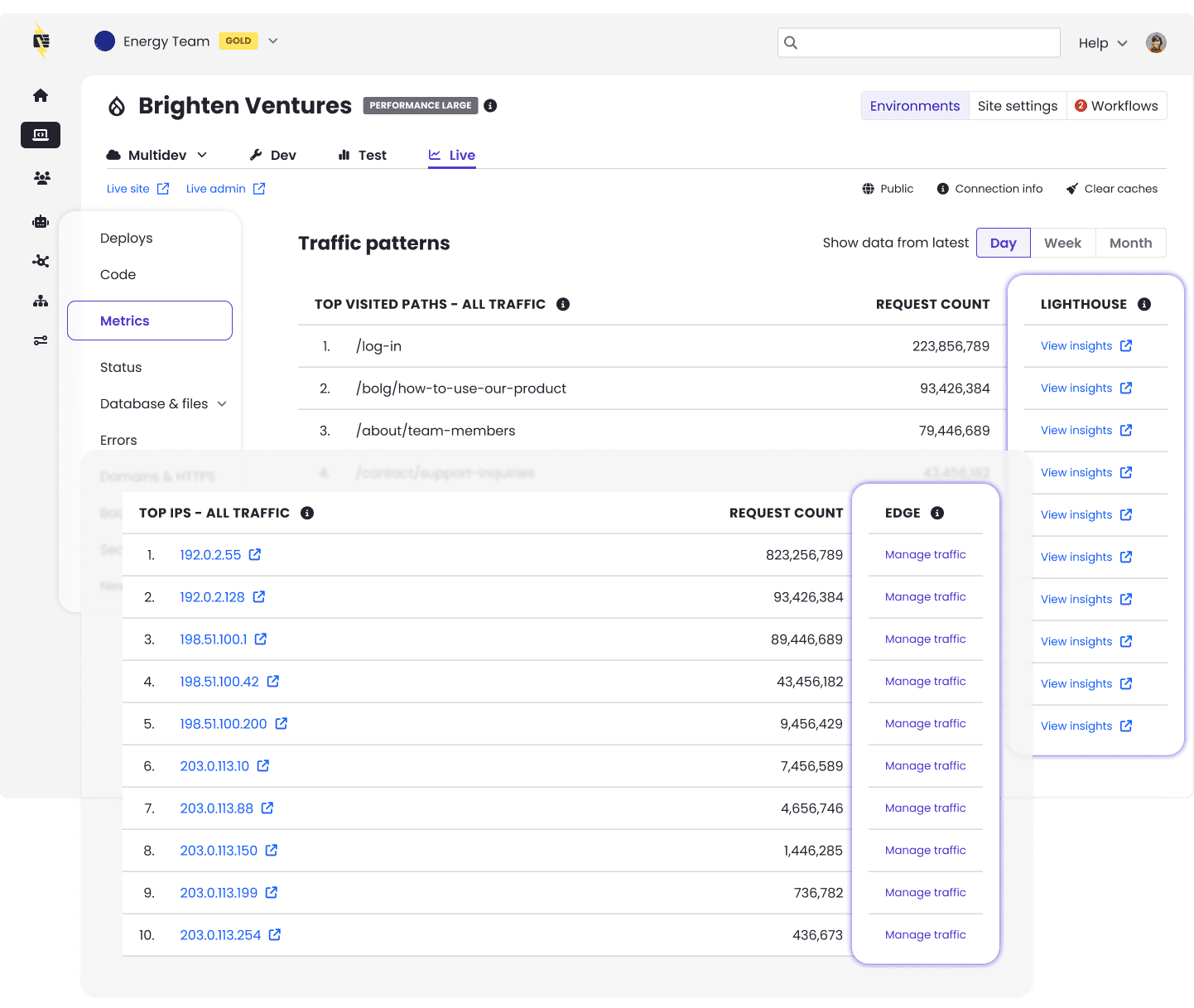
We’ve updated the Top Traffic Patterns interface, located in the Metrics tab of your Live environment dashboard, to give you deeper visibility into your site's traffic. You can now see the exact request count alongside each of the metrics IPs, User Agents, and Paths.

By surfacing the exact volume of requests, it is much easier to measure the true impact of specific actors or pages. These counts help you confidently decide if an aggressive scraper warrants being blocked, or exactly how much load a highly visited path is handling so you can accurately prioritize your caching and optimization efforts.

Note: The Top Traffic Patterns feature is in active, iterative development. You can expect frequent updates and new enhancements in the near future.

metrics page now shows request count