Pantheon release notes

Your destination for staying informed about our latest innovations and product updates.
Subscribe to RSS feed
Tools & APIs
June 29, 2026

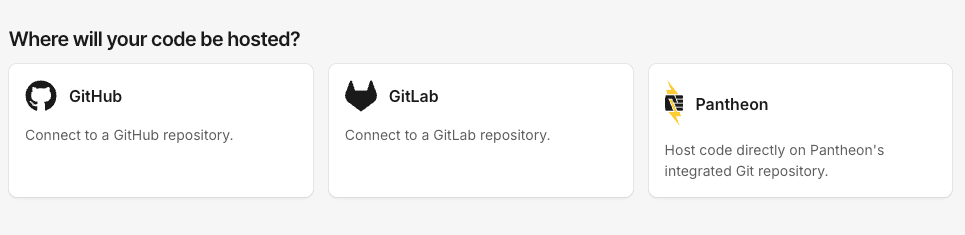
Pantheon's external repository integration now supports GitLab in addition to GitHub. You can connect a GitLab repository to a Pantheon site via Terminus using --vcs-provider=gitlab, with support for both GitLab.com and self-hosted GitLab instances.

What's new

  • GitLab repository support — Create Pantheon sites connected to GitLab repositories using terminus site:create --vcs-provider=gitlab
  • Self-hosted GitLab — Connect sites to self-hosted GitLab instances using the --vcs-host=<your-gitlab-domain> flag
  • Token-based authentication — GitLab uses legacy personal access tokens or group access tokens rather than OAuth. Tokens require api and write_repository scopes. Group access tokens also require a Maintainer role or higher to create repositories and manage webhooks.

For full setup instructions, see the external repositories documentation.

June 23, 2026

Terminus 4.3.2 is now available. This release adds GitLab support for VCS commands, a new --custom-domains flag for drush:aliases, and custom build path support.

Key improvements in this release

  • GitLab support for VCS commands: vcs:connection:add and site:create now support GitLab as a VCS provider, enabling customers using GitLab to manage repository connections via Terminus. (#2873)
  • --custom-domains flag for drush:aliases: A new flag allows including custom domains in generated Drush alias files. (#2779)
  • Custom build path support: You can now pass a custom build path when creating sites. (#2851)

How to upgrade to Terminus 4.3.2

If you use Homebrew (macOS-only) to manage your Terminus installation, you should upgrade using:

If you installed Terminus directly from the .phar file, you should upgrade using the self:update command:

For more information about this release, visit the GitHub release page.

If you have questions or concerns around Terminus, please use the Terminus issue queue.

June 15, 2026

Terminus 4.3.1 is now available. This patch release makes the --org option required for site:create, enforcing the requirement that all new sites belong to an organization.

Key improvements in this release

  • --org now required for site:create: The --org option is no longer optional when creating sites. Previously a warning was displayed; now omitting --org will return an error with a clear message. This aligns Terminus with the platform requirement that all sites belong to an organization. (#2845)

How to upgrade to Terminus 4.3.1

If you use Homebrew (macOS-only) to manage your Terminus installation, you should upgrade using:

If you installed Terminus directly from the .phar file, you should upgrade using the self:update command:

For more information about this release, visit the GitHub release page.

If you have questions or concerns around Terminus, please use the Terminus issue queue.

June 15, 2026

We've released the final update to the build-tools-ci Docker image. We will not publish any further updates, bug fixes, or security patches to the following tags:

  • pantheonpublic/build-tools-ci:9.x-php8.2
  • pantheonpublic/build-tools-ci:9.x-php8.3
  • pantheonpublic/build-tools-ci:9.x-php8.4
  • quay.io/pantheon-public/build-tools-ci:9.x-php8.2
  • quay.io/pantheon-public/build-tools-ci:9.x-php8.3
  • quay.io/pantheon-public/build-tools-ci:9.x-php8.4

Background

These base images were created at a time when CI providers recommend using customized Docker images to speed up execution and reduce the need for replicating boilerplate configration. It has since become more common to run CI jobs on standard base images for speed and the reduction in boilerplate code comes from reusable GitHub Actions or CircleCI Orbs.

Recommended migration

Use a standard base image from your CI provider and install the Pantheon tools you need during the CI run. Standard images are better cached by CI runners, so your pipelines will perform better overall than with a custom image.

Learn more about Pantheon's reusable GitHub Actions and CircleCI Orb.

Action required

If you use any of the build-tools-ci image tags listed above, migrate to a standard base image before the included dependencies become outdated.

June 2, 2026

Customer Scheduled Jobs is now available to all Pantheon customers. The feature allows you to schedule automated cron jobs tailored to your site's needs — set the frequency (hourly, daily, weekly, or monthly) and the actions to perform, and Pantheon handles execution automatically. Each site has a daily budget of 300 minutes for running jobs.

Previously limited to Early Access participants, the feature is now open to everyone with no enrollment required.

What's changed

  • Customer Scheduled Jobs is now available on all eligible sites without Early Access enrollment.
  • The Terminus Scheduled Jobs Plugin can be installed and configured on any site.

No action required

If you're already using Customer Scheduled Jobs, your configuration continues to work. New users can install the Terminus plugin and start scheduling jobs immediately.

More information

For setup instructions and usage details, see the Customer Scheduled Cron Jobs documentation.

May 26, 2026

Terminus 4.3.0 is now available. This release adds GitHub Enterprise Server (GHES) support for VCS commands, enabling customers using GHES to provision and manage their repositories through Terminus.

Key improvements in this release

  • GHES provisioning command: New vcs:github-host:add command allows provisioning GitHub Enterprise Server hosts for use with Pantheon VCS integrations (#2838)
  • GHES support in VCS commands: Existing VCS commands now accept a --github-host option to target GitHub Enterprise Server instances (#2840)
  • Twig dependency update: Updated the twig templating dependency (#2841)

How to upgrade to Terminus 4.3.0

If you use Homebrew (macOS-only) to manage your Terminus installation, you should upgrade using:

If you installed Terminus directly from the .phar file, you should upgrade using the self:update command:

For more information about this release, visit the GitHub release page.

If you have questions or concerns around Terminus, please use the Terminus issue queue.

May 15, 2026

Terminus 4.2.2 is now available. This release adds object cache and search visibility to site:info, upstream fields to site listing commands, and Node.js dependency update support.

Key improvements in this release

  • Object Cache and Search status in site:info: site:info now shows whether Object Cache (Redis) is enabled and which search index (Elasticsearch, Solr, or both) is active (#2812)
  • Upstream fields in site:list: site:list and org:site:list now support upstream and upstream_label as optional --fields values (#2835)
  • Node.js dependency updates: upstream:updates commands now support Node.js sites for dependency management (#2828)
  • EVCS site creation validation: Site creation for EVCS sites now uses server-side repo name validation for more accurate error messages (#2831)
  • PHP 8.2 fix: Resolved deprecation warnings for dynamic property creation in the Site model (#2813)

How to upgrade to Terminus 4.2.2

If you use Homebrew (macOS-only) to manage your Terminus installation, you should upgrade using:

If you installed Terminus directly from the .phar file, you should upgrade using the self:update command:

For more information about this release, visit the GitHub release page.

If you have questions or concerns around Terminus, please use the Terminus issue queue.

May 15, 2026

We've made it easier to auto-instrument New Relic Browser Agent monitoring on Drupal 10.2+ sites.

Starting in Drupal 10.2, strict Content-Length headers were introduced that broke New Relic's standard Browser Agent auto-injection. You can now re-enable browser monitoring with a single pantheon.yml setting, and Pantheon's platform will handle the injection automatically. Changes take effect within a few minutes.

WordPress sites and Drupal versions prior to 10.2 are unaffected. Browser Agent auto-instrumentation continues to work out of the box for those frameworks.

For full details, visit our documentation page on New Relic.